
ON THE ROAD
malkes

Bine, Regina, Seppel, Katharina, Jutta, Geigi & Gogo in front of the house they lived in until they started with the bus.
At the end they all lived together in the house in Malkes a small village close to Fulda. Here they prepared for the great trip.
Geigi and Manfred rented the house at first just to get out of the city. then Katharina as a close friend of Geigi came in. The bus was bought and one after the other moved in. At the end Geigi, Manfred, Katharina, Hermann, Jutta and Gogo lived permanently in the house.
It became a new centre beside the old Lanneshof where the rest of the Zwiebel were. The entire year before they finally took off with the bus Malkes was the centre for Music, Dreams and preparations. Geigi was working as an Electrician, Manfred and Hermann were doing driver jobs. Katharina and Bine were still preparing for their high-school graduation, Jutta was making some cleaning jobs and Seppel was still at home and in school, but he organized all car-parts needed for the bus because his owned a company selling that stuff.

Bine & Jutta in the back of the bus on the day they bought it.
Geigi and Gogo were very much into the bus preparations. Hermann received some money from his grandmother to buy the bus. They out together 7000,- DM and bought it from a guy in Gläserzell who already had fixed the bus from a regular 40 seat vehicle to a RV. They only had to fix it for their needs as a group of 8 people. which suppose to be the core of the group which finally suppose to leave Fulda.
It was not always clear who was joining the bus. A lot of disturbing discussions developed during the preparations. Manfred was pulling back and fourth and finally the group decided not to take him with them. But at the end he was part of it.
Ali came from Berlin and also he was denied. He didn't care and went back to Berlin.

First ride with the bus
The bus was prepared in the barn of an old farm house where some friends of them lived. It was fun to work on the bus, to make it livable for 8 people. A kitchen with a gas stove, a wardrobe, shelves, a moveable board, a bunk bed with space for eight.
Geigi brought August to Fulda.
Off Germany - DEPARTURE

The bus is packed and ready to go…
On August 13th 1981 Seppel, Bine, Jutta, Katharina, Geigi, Manfred, Gogo, Hermann and Ivan the dog are leaving with the bus.
It was noon. Some friends had gathered in Malkes to say goodbye. The last things were packed up frantically, and some separated in tears from their friends. Hermann had hidden behind the curtains in the back of the bus and waited with a bad mood finally to drive, which was incomprehensible even for him.
After about 100 km driving they met an old friend In Usingen in the Taunus. It was already in the evening.
They spent the first night on the Rhine near Rüdesheim, somewhere off a small country road on a field path.
They decided to go to Rüdesheim the next day to play in the street for the first time. The 450 DM in the till should not be touched unless it was an emergency.
14.08.1981
Rüdesheim was not a good place to play. The city was full of tourists, but there was no pedestrian zone or place.
They continue to Koblenz and had their first performance on that trip. Very little response. They had no real program yet, and by the still existing shyness only chaotic stuff came out. They decided to go to Cologne to play in the evening on the Domplatte.
Hermann calls his parents and asks to meet them in Cologne.
But even in Cologne there was little resonance. During the final fire-show Hermann swallowed some of the fuel. Cough and nausea plagued him later that night.
The same night they continue to the Dutch border.
Right before the border, Geigi demonstratively burns his military service papers. A symbolic act to turn Germany's back.
The Dutch customs discovered that the group was carrying some old looking instruments and they did not allow them to pass the border because they suspected that they wanted to sell the instruments illegally. After long discussions the bus was left in the parking lot between the borders.
15.08.1981
Early in the morning the customs officer let the bus pass trough after a further assessment of the instruments, .
They left Germany and went to Nijmegen, sleepy and angry.
La France ‘81
16.08. - 29.08.1981
NIJMEGEN - ARNHEM - BELGIUM - ROUEN
For the first time, they are on the road in France. The problem with language is getting worse, but Manfred's knowledge is enough for their daily needs. Katharina learns French.
On the street, they meet other performers.
Katharina has to visit a medical-doctor. They are using their foreign travel insurance and an ADAC-check for the first time.
Ivan still has no real reference person and suffers from the tightness of the bus. In Rouen he nearly stepped in front of a car. Katharina takes care of him.
ALENÇON
A small cozy town where they play on a square in the center.
On the outskirts of the city, they camp in a meadow, get milk from the farmer and practice their horn instruments and saxophones for playing Dixieland for the first time. They play pieces from the Beatles, first of all "Yellow Submarine", which soon is changing to Rainbow Submarine and becomes their hymn.
LEMANS

Bine is practicing in LeMans …
On the street during their performance, they met a woman who invited her to her home and helped her make a paid performance in a suburban district. She is a social worker and tries to get a bit of color in the dreary concrete silos with our appearance. At the performance, they are bombarded with a stones.
You have an evening a house almost by itself and use it for bathing and showering. They celebrate a party.
Some days they live in a forest.
Hermann has secret doubts, which lead him to ambiguous feelings and thoughts. He experiences a crisis.
NANTES
Everywhere there are posters of the autonomous movement of Brittany.
PORNIC
They reach the sea for the first time. (Katharina)
Seppel learns playing Mousette dances on the accordion
LAROCHELLE
They play at the port in the cafes and earn a lot of money. Manfred plays solo and performs songs by Jaques Brel and enthuses his listeners.
The bus is located at night near the port in a parking lot, where under plane trees on dusty ground many youthful backpackers stay overnight.
Bine is practicing in Nantes
02.09. - 28.09.1981
BORDEAUX
They arrive the city with a broken brake, the first time the bus has been damaged.
They put the bus in a parking lot right next to the American circus, which is questing in town at the same time.
LACANAU OCEAN
Hermann knows a beach close to Bordeaux from a vacation trip some years ago. Their they supposed to meet August for the planned workshop. He comes with his girlfriend. However, the workshop is not taking place because in the same time five friends from from Fulda are arriving, Biggi and Susanne accompanied by Ali, Marion and Regine. Old relationship stress is dominating the stay and they cancel the workshop.
Ali came to stay. No discussion this time.
Biggi and Hermann have a birthday. Hermann colors his hair red and takes a LSD trip.
August teaches how to make mayonnaise.
Ali is teaching Seppel how to juggle.
Manfred and Jutta are practicing Beatles-songs with Seppel and Katharina, a capella.
They agree on a new meeting with August in the winter somewhere further south.
August is considering openly with the idea of joining the bus for the first time.
BORDEAUX
They have success in Bordeaux and making so much money with their street-performance that they only have to work on weekends. During the week they are living on the beach in Pyla sur Mer close to Bordeaux.
Geigi's sister Gundi comes for a visit.
Christian from Munich, finally was able to sent them the sound system they were waiting for since the beginning. Now they can play with electric guitars in the street.
Biene falls in love with Luigi, who works at the American circus in the elephant tent. He's getting them all free tickets to a show.
There's a lot of work to be done on the beach. Everyone learns to juggle. Bine, Jutta, Ali and Seppel are developing a new piece: The Doll.
Ali is bringing a lot of new ideas and is having a lot of fun with Seppel.
In Bordeaux, the new pieces are being tried out. Dixie music becomes a part of her show.
Stealing in department stores has become fun for some of them until Ali and Hermann gets busted. They were banned from the store, nothing more, but it was a reminder.
They try to buy dope for the first time and get ripped off.
PYLA SUR MER
Celebrating Seppel's birthday in Pyla with with stolen gourmet food.
A letter from Christian in Munich tells about his indictment against throwing stones at a demo in Berlin. He was in custody. The events in Berlin made them very concerned.
During a shopping tour in Arcachon, the bus gets into a customs check. The bus is being thoroughly searched for drugs. Nothing is found.
BORDEAUX
It's getting autumn.
A nightly storm is ringing in the autumn. They are staying mainly inside the bus. It's raining. They are making plans for the winter and consider going to Mallorca. After Biene is receiving her new flute from Germany they decided to drive on.
At the last performance in Bordeaux, a woman invites them to dinner at her house.
At the last performance in Bordeaux, a woman invites them to dinner at home. It was a sumptuous meal for the vegetarians. Since the apartment was in a block of flats, they aren't able to make any music though they inviting the family into the bus, drive out into the woods and play their entire repertoire.
Leaving Bordeaux. At the moment of departure, Christian and Garry ask to stay for a few more days.
Christian and Garry, a Danish and an English guy picked up as hitchhikers are joining them. They'll be with them for a while.
Biggi & Geigi meeting in Lacanau
Bin & Jutta performing a scetch
BORDEAUX - LACANAU - PYLA SUR MER
Bine & Christian
Biggi meeting Geigi in Lacanau Ocean


1.10.-14.10.1981
TOULOUSE
It was raining, so they could hardly play. The police also made trouble and sent them away.
They had gotten used to laundering their clothes in the launderette for a lot of money and combined this often with visits to the supermarkets. Stealing food became a sport. Once one of them was caught, the whole group was thrown out of the supermarket. Strangely enough, the police never played a role in this.
They were enjoying themselves in their gypsy life and showed it through their colourful clothes.
They met an Englishman who told them about a convoy of buses, coming from the summer festivals in southern England to the continent and wanting to meet at the Mediterranean near Perpignan. He described a possible rendezvous point on the coast.
During the journey they often picked grapes and processed them into grape juice. The fermentation and shaking in the bus caused the bottles to explode.
In the meantime, Biene had fallen in love with Christian. He and Garry left the bus because they wanted to go to the grape harvest,
CARCASONNE
For the first time they are in financial problems because the group performances in the street don't bring any more money. Some of them play individually and it becomes a tedious compulsion to perform. Seppel plays alone with the accordion for hours. Geigi and Hermann try Irish songs with violin and guitar. They also try to perform in restaurants. the question is: Do they put all the money into the common purse or can they put in their own money?
Geigi has a fierce quarrel with Manfred.
Catherine has to have a surgery because of her troubles with her wisdom tooth.
They managed to get a stage appearance in the pub "La Petassou". They plan something special and design a show just for this evening. It became a disastrous dilletant failure, but the excessively well-meaning audience saved the evening.
On the last day they had a meeting with two gypsies who wanted to exchange a violin for a viola. The gypsies met them on a large parking lot and presented a Mercedes trunk full of violins. Geigi could not resist and gave his viola, which he had borrowed from a friend in Fulda, for a violin he liked.
Seppel, Ali & Manfred checking out Carcassone
14.10.-28.10.1981
Marion, Jutta, Geigi, Ali & Bine at the beach in Carnet-Plage
PERPIGNAN
There is little opportunity to perform in the streets. There's a long pedestrian promenade winding through the old town and at its end a square with a few cafés.
Seppel is performing alone with his accordion and plays the same musette dances over and over again. He had bought the sheet music in Bordeaux and was now studying it. While he was playing, he tapped from one foot to the other in the rhythm of the three-quarter beat and smiled at the many schoolgirls who are standing around him adoringly.
CARNET-PLAGE

They drove down to the sea again and camped in a quiet place. Laundry flutters to dry on a big line in the wind. The police came and wanted to send them away because they did not tolerate gypsies. The group referred to the nearby tourist centre and explained that they were young Germans on holiday and would stay. But the laundry was no longer allowed to be hung up. That's why they wanted to leave.
Mario, their friend from the Zwiebel in Fulda, came to visit. He was on holiday with Marion and on his way back from Barcelona to Germany. He stayed with them for a few days.
In town they heard again about the English and that those people were camping on an occupied beach nearby, where a citizens' initiative protested against a building speculator. They decided to go there.
BOURDIGOU
They came to a vast desolate and deserted area. Here and there were some remains of old huts and a few bushes. A road, furrowed by heavy construction machinery, meandered through the terrain. It didn't seem like anyone was there. But Geigi and Marion had already driven up with Mario's little bus and explored everything. They showed the way. Slowly the bus staggered through the holes filled with deep water. Finally they were able to see the woodwork of the tip of a tippie and then next to it a bus and other vehicles. They were converted trucks with camping bodies. They found a convenient place to build up their camp close by.
lightly shy and hesitant, they made the acquaintance with the English peolpe.
They were only a few steps away from the dunes that separated them from the sea. Not a single building was visible far and wide. Only nearby was a hut with a high straw bridle standing around. There lived an old fisherman, the last of a colony.
To meet these English hippies changed their everyday lives. They no longer drove into the launderette, but washed the laundry in large pots over an open fire. They also only cooked over open fire and ate their meals outside as long as it wasn't raining. They saved the gas for other occasions. This also saves them a lot of money. Jutta became the guardian of the fire.
Immediately on the first morning the English brought them a plastic bag full of marijuana, which they smoked at first hesitantly but later without shame regularly. The entire group has been high all day.
They developed an enormous amount of energy. Since some of the Englishmen also made theatre on the street, they showed each other their stuff and practiced together. They rehearsed music pieces and worked on the musical accompaniment of their pantomime pieces.
They lay naked on the beach and enjoyed the still warm autumn sun.
Mario tried his wind-surfing board and failed with a broken mast.
Ali and Seppel practiced juggling with homemade clubs. Bine trains unicycling with Ali.
They constantly collect wood for the fire and fetch water from an old well.
The sun rose over the Pyrenees, which one morning were covered with snow.
One evening everyone who lived in Bourdigou sat around a big campfire. A big pipe was passed on. Someone played flute and guitar. They were far from the world.
That evening in the Tippie of the Englishmen with fourteen people, Geigi developed the idea to get a Tippie of this kind at some point. Over the fire there was a pot with a simple pumpkin soup and people crowded against the tent wall. One was too busy with this fascination to feel the pain of the eyes tormented by the biting smoke.
In between they went to Perpignan and performed in the street, or played music in a restaurant in the evening. Burned brown and covered with sea salt, they seemed to be completely lost in reverie.
They played several times in a restaurant (Geigi knows the name). At a last performance there, Hermann fell in love with a red-haired French woman.
Eventually autumn storms came up. They tried to protect themselves from it for a few days, but it was clear that they had to go on.
Mario and Marion left them and went back to Germany. Mario wondered whether he would join them next year. His farewell and the farewell to Bourdigou was like a cut-off from the past. But it was only an illusion, as well as the "strong feeling of freedom" they experienced in Bourdigou.
Marion, Jutta, Geigi, Ali & Bine at the beach in Carnet-Plage
Histoire du Bourdigou par Mr Carrère Lucien Contact : lucien.carrere@orange.fr ou visitez le blog : http://laviedubourdigou.blogs.fr
There are developments in the territory that would cause any prefect to pull his hair out. The typical example is the Bourdigou in Sainte-Marie. At the beginning of the 20th century, this small corner of the beach was built by the fishermen, some cabins, where they store their fishing gear. Some even live in it during the summer months. From 1936 onwards, with paid holidays, some families from the county came to build straw mats to spend the holidays there. Totally shaved in 1943 by the German occupiers, the Bourdigou was reborn from its ashes after the war. Then begins the conquest of the West, Sainte-Marie-la-Mer version. Little by little, constructions were added to those of the fishermen, including Galdric, an old fisherman Piannenc, who would be the soul of the village. "We choose a small plot of land, not far from the beach, we plant four stakes and build a shack in the middle. Preferred materials: reed and wood. How? Building permit? Purchase of land? Notary? Prefect? Késacko? We didn't give a shit."
At that time, there was no coastal law, no law at all. Just an extreme freedom and a huge conviviality between the people of this holiday city of a new kind. Over the years, the barracks have been improved, parties and barbecues organized and neighbours invited. We're thinking of the layout. Major roads are drawn between the huts to allow traffic. We find solutions for hygiene, waste water disposal.
Little by little, the Bourdigou is transformed into a real village with its streets and squares. At the end of the 1950s, it had 200 sheds. A Catalan village, where the locals make up 9/10th of the population. A village with a simple life where mutual aid is strong. "We take care of the neighbour's children, we get down from Perpignan what he needs. A village of freedom, no police, no lifeguard, no delinquency, no drowning and no moroseness." We'd party, bathe as we wanted, not bother. It was beautiful for the people who lived there," confides a witness of the time.
In the 70's, the hour of glory of the Bourdigou sounded. The phenomenon is growing incredibly. Almost all of Europe arrives: English, Dutch, German especially. Le Bourdigou appears on tourist brochures in Germanic language. The clandestine village of Le Bourdigou continues its anarchic expansion and now has almost 6,000 inhabitants. The trouble starts then. Fires destroy some straw huts. The prefecture asks that the village be razed. Then starts a strong protest, with petitions and clashes with the gendarmes. In 1976, sheds built on the maritime domain were razed. On 24 April 1979, under the damp eye of Galdric, the mayor of the free commune of Bourdigou, despite some clashes between the police and young bourdigueros, the rest of the barracks was razed. Not a single one has been preserved. Only remains for the elders of Bourdigou, the memory to have participated in a fantastic epic, one of the last before normalization.
Coastal development The struggle around the village of Bourdigou also marks the beginning of coastal development. All the other wild villages of the Bourdigou style, in Canet, Saint-Cyprien and Barcarès, were razed down in 1965 and gave way to the constructions of the developers. And this is how the seaside that we know from Barcarès to Canet Sud is created, a series of buildings along the beaches. As we used to say at the time:"Gold will be pouring down on the Languedoc-Roussillon". Especially in some people's pockets.
For the Bourdiguéros, the commune of Sainte-Marie offered the people parcels of land at unbeatable prices. All the houses built on the edge of the tourist information centre were sold to the "owners" of Bourdigou.
Film de Claude et Michel Marre de 1976 Hymne à tous les Bourdigueros Merci à Zip (famille Vidal/Ripoll) pour ce partage. 16mn50 ses grand parents et sa tante.


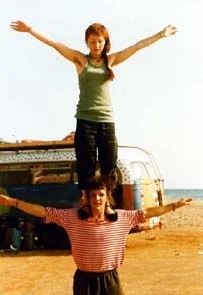
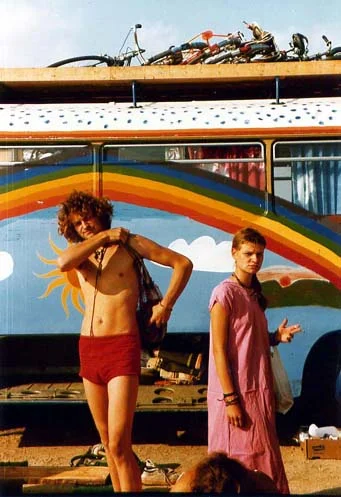
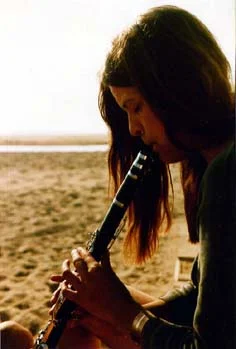
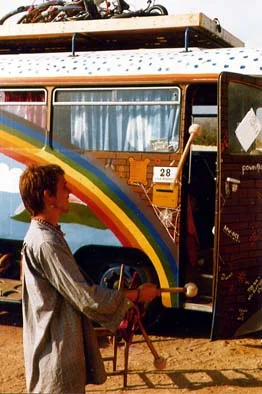
Spain ’81/’82
29.10. - 19.11.1981
BARCELONA

Gogo at Montjuic …
They crossed the border along the coast. The actually border crossing was some hundred meters above in the mountains. A violent storm shook the bus and they were afraid to be blown off the road. None of the customs officers ventured out of their booth. Geigi packed up our passports and went to them.
In the next town, Port Bou, they met a yellow Mercedes bus of the German Federal Post Office. He was driven by a young German couple who wanted to drop out and were on their way to the south.
Finally they came to Barcelona.
They found a campground on Montjuic, a hill with an old fortress above the town.
They performed on the Ramblas and in the pedestrian zone, which was closed to traffic only during the business hours in the morning and in the evening.

Ali juggeling at Montjuic
On the Ramblas, they were often chased away by the police. Once they had just begun and a large crowd had gathered around them. Two policemen stood in the middle of the circle and ordered us to pack up and leave, because we weren't allowed to play there. To the bus-people and their audience it seemed very arbitrary and as pure harassment. They were frustrated and already packing up when suddenly the audience started discussing with the policemen. They scolded and said that they were now living in a democracy, and so on. But the policemen defied the crowd with all their authority and took a threatening position. Quickly the bus-people packed up their things and disappeared. Since then, they've always looked first to see if there was a police force around.
They had very little money and were happy about 600 peseta, which Hermann found on the street.
L' ARBOÇ

Practicing Dixie-music at the shore of Pantà de Foix close to L' Arboç
They left town for a few days. Many had fallen ill, diarrhea, stomach aches and colds. They found a lake in the mountains and found their way there. It was a reservoir in a beautiful area. There they washed their laundry and rested for a while. The big city had become a strain. The noise, the narrowness and the dirt got them down. They didn't know where to go to the bathroom.
After a short time they drove back to get the money for the onward journey.
BARCELONA
From Montjuic, the city was often in the haze of exhaust fumes and there was always a loud humming noise.
They took water from the wells in the streets. The water smelled like chlorine. Against the diarrhoea they drank hop blossom tea and packed themselves warmly.
They met Anna and Gabi, a young Spanish couple from Barcelona who lived in the old city.
The sky closed with dense clouds and autumn caught up with them again. At first they thought of their old plan to go to Mallorca, but the ferry crossing was too expensive and they decided to follow the coast south, maybe as far as Seville. There they planned to rent a house and hibernate.
TARRAGONA - VALENCIA
In Tarragona they played in a small Ramblas.
Two bicycles were stolen from the bus.
They met a guy who told them about the fight against the nearby nuclear power plant. In the twilight they passed by this facility illuminated with orange light ghostly.
In Valencia they "admired" the Franco monument that reminded them of the dictatorship that had not been overcome for so long. They were repeatedly prevented from performing by the police.
Frustrated, they moved on further south.
CULLERA
At night, at full moon, they leave the main road and looked for a suitable place for the night. They end up in a rice field plantation. The moon reflected in the large expanses of water. It was a mysterious place. Then the rice fields suddenly stopped and was followed by densely packed orange plantations surrounded by high straw fences. All they could do was drive on, no space for them. Suddenly high dark towers piled up in front of them. They found themselves unexpectedly in an empty concrete tourist town. In each of the skyscrapers there was only one apartment illuminated, otherwise there was only street lighting. They stayed overnight at a car park near the beach with the invisible, quiet, noisy sea in the background.
In the next few days they picked oranges, tangerines and lemons in crates as they continued their journey.
ALICANTE
At first, the bus people lived on the outskirts of the city by the sea. Then Geigi and Gogo looted a detached uninhabited house. The prey was cookware, a little table and a lot of folding chairs. For fear of the police, they sought a new place a little further away from the city in the mountains. There they met an open truck with about twenty Scandinavian adventure tourists who drove to Morocco to cross the desert.
BAZA
It pushed them further south.
Towards evening they left the road to Granada and drove into a narrow path over a plateau. The sun was already low and shone reddish light over the brown treeless landscape. Only a sharp hill stood alone in the west. In the south you could see a high black mountain range in the distance, the Sierra Nevada and the next destination of their journey.
A little further away, they discovered an abandoned stone hut surrounded by the ruins of a former farmhouse. The hut was only used as a temporary stable for the sheep and they found remnants of straw and virgin wool.
The well on the farm had dried up. They decided to spend the night anyway, because no one wanted to drive on.
They parked the bus and got everything ready for the night. As is so often the case, the work was spread out and everyone knew what to do. They went to collect firewood, others started preparing the food and the rest explored the ruins as long as it was still bright. Often you could find something useful or discover something special, and it was always good to know where you were before nightfall.
The sun became bigger and bigger and rolled as a huge bright red ball along the sharp hill until it finally disappeared behind the horizon. Then the sky quickly became dark and the first stars blinked on like far off signals. The landscape was black and it became cold. In the end, they were wrapped in blankets around the campfire, drinking coffee. They wanted to spend the night outside.
Someone came up with the idea of writing a joint letter to the friends in Fulda. Their impressions came from the overwhelming feeling of being far away. Together they understood that they had crossed an inner boundary within their journey.
The winter began and for all of them it was the first time that they could not snuggle into the warm nest of their home. A slight creep shook them and yet a strange calm, relaxed mood spread among them. On the black night they experienced the glittering sparkle of stars in the sky, a shower of shooting stars.
The morning was cold and in the dark corners behind the decayed walls lay white frost. They departed further south.
20.11. - 23.12.1981
GRANADA
With the music of Cat Stevens, the bus slowly rolled down the serpentines to Granada. Everyone was in a good mood. On the trip they decided to spend the winter in this city. Hermann and Seppel had already been there last year to buy guitars and Hermann's parents were friends with a family near Granada, maybe they could help to find a house.
At first, however, they only found a dusty place on the outskirts of the city where they could camp and were not too far from the city centre. In the neighboring houses they received water. Everything was very dry and they learned that there had been a serious drought for two years.
Through Hermann's contact they got help by Pepe, who went looking for a house several times together with Katharina and Geigi.
The first days they played on the Bibaramblas, a square in the center of the city. The only place in the city without car traffic.
The money was short and the gigs didn't pay much. They walked through the shops and got some free fruit and vegetables.
After just a week on that dusty parking place, they couldn't find any spot to shit anymore. The dry dust settled in each crack of the bus and some people got stomach pains and became ill from the bad food.
Through their performances in the city and their eye-catching appearance, the bus people quickly make acquaintances in the city. The Germans Benny and Nicki and the Englishman Brian became good friends.
"La Cantina" was a pub run by two women and where the bus people used to stay often. Ali and Manfred had a violent encounter with two Gitanos. Fortunately, they got off lightly and it remained a threat. Later it was discovered that these Gitanos were not from the city.
Katharina met Asuvre, a dancer and actor from Madrid who was in Granada at the time. She fell in love with him. He liked the bus and the idea, but also saw the flaws. He offered the group a workshop and succeeded in getting them to use the "Centro Manuel de Falla", an event centre with a large stage.
The relationship that developed between Katharina and Asuvre led to tensions with Manfred, who was mercilessly jealous.
In the meantime they have moved with the bus to a better place above the Alhambra. They camped at the edge of the forest. Then the weather changed. A long awaited rain came in. But it also got colder.
Shortly afterwards they met Heiner and Dorle, who were on tour with a VW-bus.
Benni and Nicki lived on the Sacremonte and through them they got to know others, like Loli.
Hashish was consumed everywhere and by everyone. Since Bourdigou, the bus people hadn't smoked that much.
Seppel got to know Amparo and talks about desert parties.
LA FRANCE ‘82
BOURDIGOU

Back on the beach of Bourdigou RS finds remains of the Englishmen from last fall. A small group of people is still living there in very bad conditions, addicted of heroin, without money and any idea how to get out of it. It was a terribles experience and also a warning what could happen if you don't follow an idea.
Mario joined them for good. This time he brought Snorre a friend from Fulda for a few days of visit.